



First, a meta question I always think about when considering the topic of automation and abundance. Why are we so afraid artificial intelligence will automate tasks that many people just fundamentally hate? You can maybe be afraid AI kills us. But I don't think that's the actual reason everyone is anxious, except my wife who has a very real fear of humanoid robots. So maybe that's a subset of people. But many of these tasks are so boring and antithetical to the human spirit that Hollywood made three critically acclaimed movies just in the year 1999 around this exact narrative motif.

Fight Club (1999)

The Matrix (1999)

Office Space (1999)
Three depictions of the late-1990s office worker, as imagined by Hollywood: hollow in Fight Club, trapped in The Matrix, and taking a bat to the machinery in Office Space. Long before AI, popular culture was already asking why we spent our lives this way.
Ezra Klein, co-author with Derek Thompson of Abundance, offers a reasonable answer in a recent conversation about AI and the public good: the fear is fundamentally about distribution. People can imagine AI creating enormous abundance. They simply do not trust that any of it will go to them.
Abundance is the result of an economic loop
A positive productivity shock is not a pile of money waiting to be divided. It creates a saving. It does not determine where that saving goes.
AI has already shown that it can create a real surplus. In a study of 5,172 customer-support agents, a generative-AI assistant increased issues resolved per hour by 15 percent on average. The gains were largest among less-experienced workers. It was one company and one measurable workflow, but the premise is no longer hypothetical: some work can become more productive. Brynjolfsson, Li, and Raymond (2025)
The company can keep the saving as a larger margin. It can lower prices, raise pay, serve more customers, shorten hours, or employ fewer workers. Every possibility begins with the same technical achievement.
A productivity gain becomes abundance only when it successfully moves through a loop. Lower costs become lower prices. Lower prices create new customers. Larger markets justify more investment, greater capacity, specialized labor, and further invention. Workers eventually earn more in an economy where their pay also buys more. That purchasing power creates demand and the loop repeats.
A productivity dividend is the first step. Abundance comes from repeating the loop.
None of this is automatic. Competition affects whether savings reach consumers. Finance affects whether opportunity becomes investment. Workers need routes into the new work. Productive activity also happens somewhere, and people must be able to reach it. That makes housing one of the links in the loop.
Housing policy affects who benefits from a productivity shock
The distributional debate usually stops with labor and capital. Will the saving become profit or pay? That accounting is incomplete because workers spend their pay, and they often have to buy access to the place where their labor is most valuable.
Suppose AI makes the Bay Area much more productive. A renter already there may receive a raise and then pay more in rent. An incumbent homeowner may receive the same labor-market gain while the value of his house rises too. A teacher, nurse, technician, or young software engineer living elsewhere may never move because the wage premium does not cover the cost of entry.
Richard Hornbeck and Enrico Moretti show what a local productivity boom looks like after housing adjusts. They study manufacturing-productivity shocks across 193 American metropolitan areas and trace the local effects for three decades. More productive cities paid more. They also became more expensive. Hornbeck and Moretti (2024)
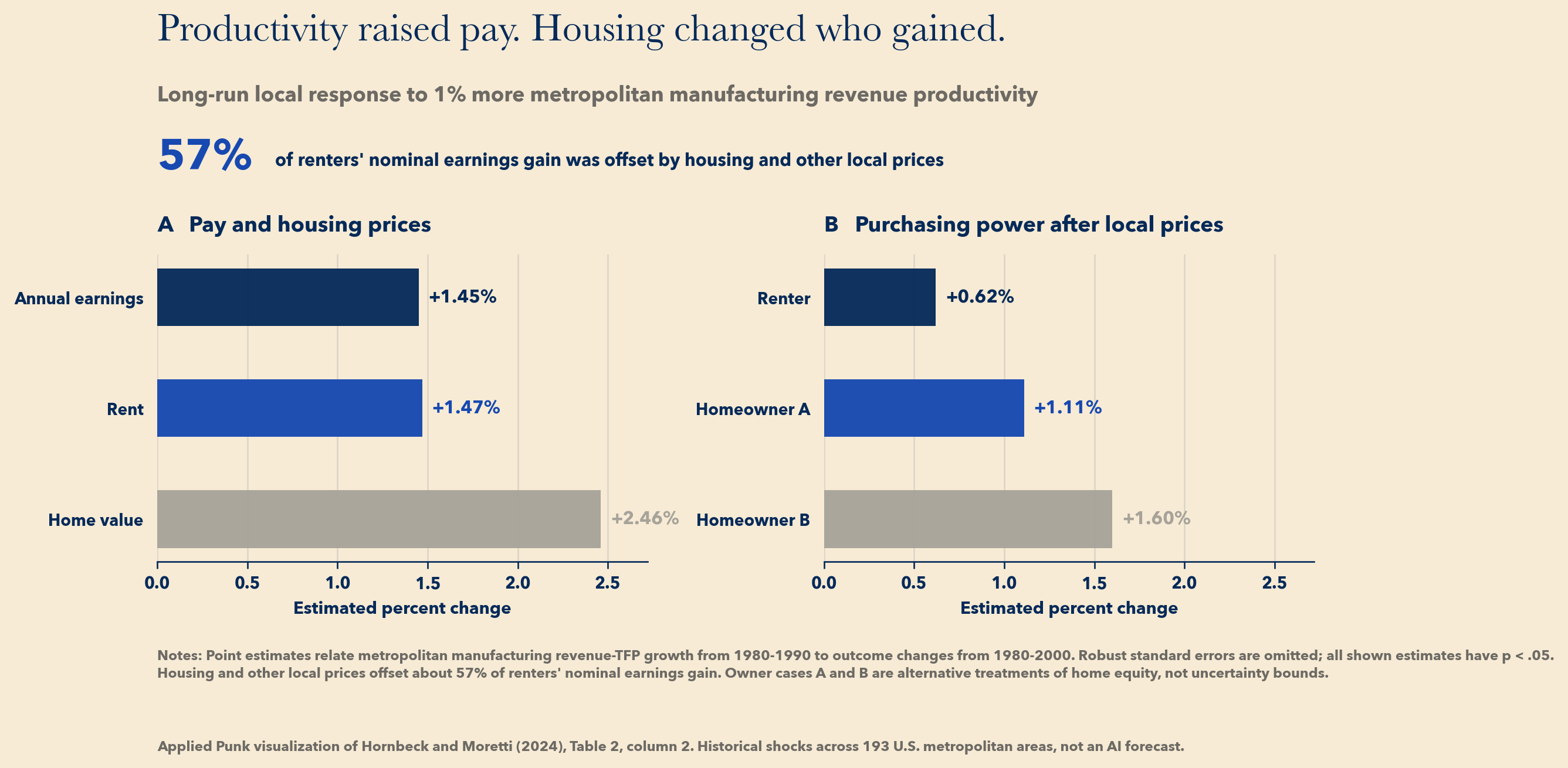
Figure 1. Long-run point estimates for the 1980-2000 local response to a 1 percent increase in metropolitan manufacturing revenue productivity during 1980-1990. Annual earnings rose 1.45 percent, rent 1.47 percent, and home values 2.46 percent. Estimated purchasing power rose 0.62 percent for renters and 1.11 or 1.60 percent for incumbent homeowners under two alternative treatments of home equity. Housing and other local prices offset about 57 percent of renters' nominal earnings gain. All displayed coefficients are statistically significant at the 5 percent level; robust standard errors are omitted for legibility. Historical manufacturing evidence, not an AI forecast. Applied Punk visualization of Hornbeck and Moretti (2024), Table 2, column 2.
In the long-run estimates, a 1 percent increase in local manufacturing revenue productivity was associated with annual earnings that were 1.45 percent higher. Renters still gained. After accounting for housing and other local prices, their purchasing power rose an estimated 0.62 percent. Using the authors’ point estimates, higher local prices offset about 57 percent of the nominal earnings gain.
The boom drew in people too. Local employment rose an estimated 4.16 percent. That result does not isolate housing’s role, but it shows that a productivity shock changes the number of participants as well as the value of what existing residents own.
Incumbent homeowners gained more because they received the labor-market gain while owning an asset that became more valuable. The two homeowner estimates are not uncertainty bounds. They reflect different assumptions about whether housing wealth can be consumed through borrowing, moving, or heirs living elsewhere.
Then there is the person who never appears in the figure. A worker outside the city receives no local wage gain and owns no appreciating local asset. If housing is scarce enough, the move may no longer pay.
This is where housing changes the loop itself. Restrictions do not merely transfer part of an existing gain from renters to owners. They can reduce the number of people who join the productive cluster, the number of matches between workers and firms, and the size of the market supporting the next round of investment.
A landlord does not have to build a model, train a worker, or understand the technology. When valuable activity concentrates where housing cannot expand, ownership of the scarce location is enough to capture part of the gain.
The industrial revolution and the origins of abundance
The Industrial Revolution automated tasks previously performed by skilled artisans and placed the machines under the control of capital owners. Capitalists wanted profit. Landowners wanted rent. Workers had every reason to fear that the machines would make someone else rich.
Why did the result eventually become mass abundance?
Not because the owners became less greedy. Productive capacity kept expanding. Cotton gives us the cleanest numbers. From 1784 to 1820, the estimated cost of processing a pound of medium British cotton yarn fell 88 percent, while cotton throughput rose from 11.3 million to 120 million pounds. Leunig and Voth (2011); Harley (1998)
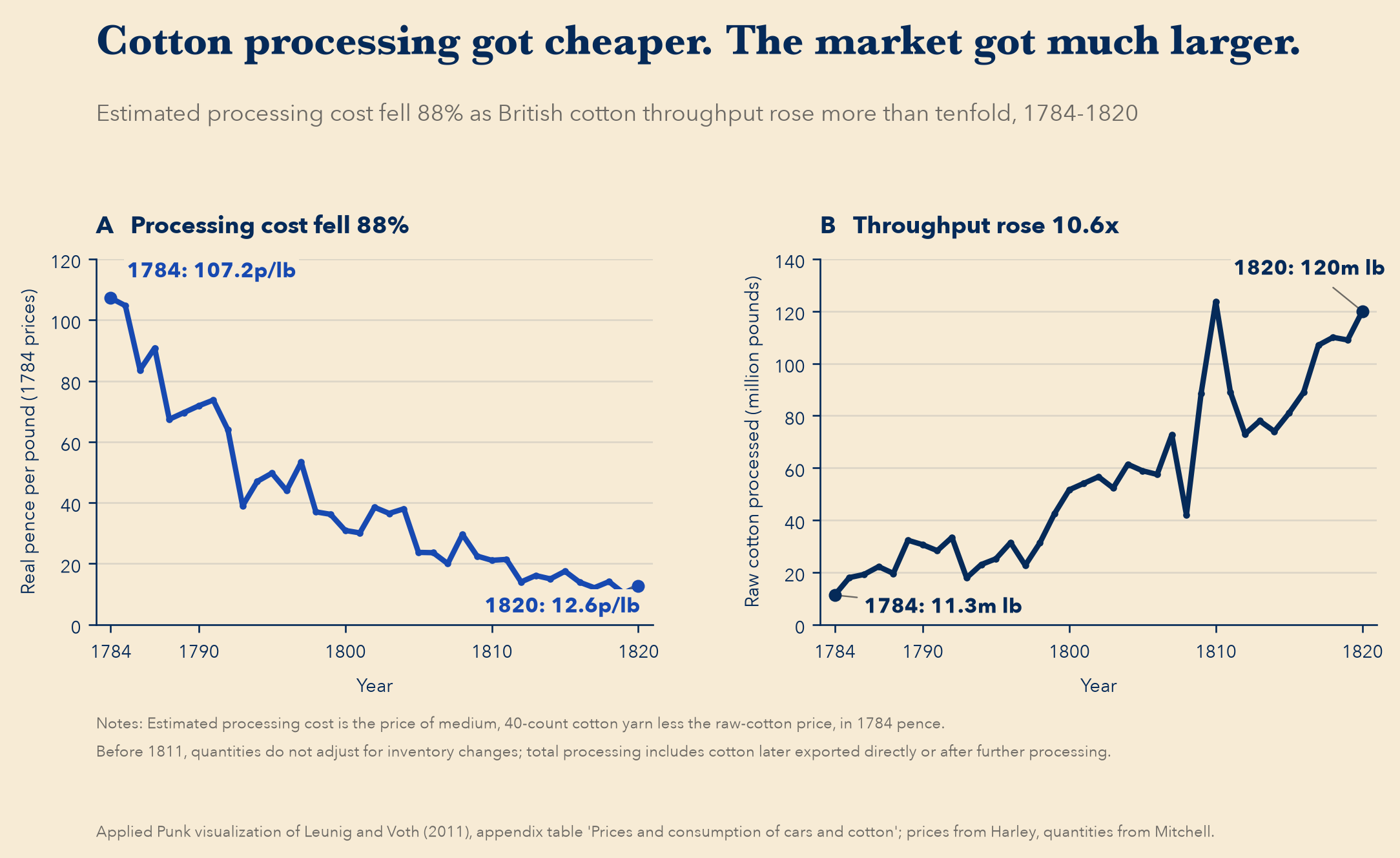
Figure 2. Estimated processing cost for medium cotton yarn and raw cotton processed in Britain. Processing cost fell from 107.2 to 12.6 pence per pound in 1784 prices, while throughput rose from 11.3 million to 120 million pounds. Quantities before 1811 do not adjust for inventory changes, and total processing includes cotton later exported directly or after further processing. Applied Punk visualization of Leunig and Voth (2011), appendix table “Prices and consumption of cars and cotton.”
The machine lowered costs. Profit attracted capital and new producers. Capacity expanded. Competition pushed some of the saving into lower prices. Lower prices helped unlock mass demand. Larger markets justified more investment, specialization, and invention, which lowered costs again. Evidence from early Lancashire firms suggests that extraordinary profits did not remain with the first producers forever. Entry and expansion passed part of the gain to buyers. Harley (2012)
That loop did not make the transition clean or fair. British cotton was embedded in global trade, slavery, and empire. Particular crafts were destroyed, and productivity initially outran the purchasing power of many workers. Allen (2009); Crafts (2022); Olmstead and Rhode (2018)
What was new was compounding. Manufactured goods and machines could be reproduced. When demand rose, firms could build more capacity, hire and train more people, and make more goods. Private ambition produced a broader dividend because output could expand and competition made it difficult to preserve every saving as a permanent rent.
A productive address is different. Homes can be reproduced. A particular location cannot, and new homes can appear there only if physical capacity and public rules allow it.
AI productivity is geographically concentrated
AI looks placeless because its output is digital. Much of its value may travel nationally through cheaper software and services. The firms, workers, investors, and knowledge networks producing the frontier are still located somewhere.
Brookings estimates that the Bay Area accounted for 13 percent of U.S. AI-related job postings in its 2025 analysis. San Francisco and San Jose were the only two of 195 metropolitan areas classified as AI “Superstars” across talent, innovation, and adoption. Muro and Methkupally (2025)
Concentration is part of how productive clusters work. Workers find specialized firms. Firms find specialized workers. Ideas, capital, and new companies circulate among them. But those benefits depend on people being able to enter the cluster.
Remote work can weaken the link between a job and a particular office. The pandemic showed that technology can redirect housing demand across cities. It rearranged geography. It did not abolish it. Mondragon and Wieland (2025)
This is not a prediction that Bay Area landlords will capture the national AI dividend. Digital products can become cheaper for consumers everywhere. The claim is narrower. To the extent that frontier firms and complementary workers remain concentrated, housing restrictions raise the price of joining that economy.
That affects more than distribution after the boom. A smaller accessible labor market means fewer potential matches between workers and firms, fewer people sharing knowledge, and less capacity for the cluster to support the next round of companies and investment.
Housing restrictions limit abundance
Housing demand can resolve itself in two ways. A place can add homes, or households can bid more aggressively for the homes that already exist. The demand shock can be identical. The supply response determines how much appears as quantity and how much appears as price.
Raven Saks estimates exactly this adjustment. She compares the response to the same 1 percent labor-demand shock in metropolitan areas at the 25th and 75th percentiles of a housing-supply regulation index. The less regulated place is roughly Denver. The more regulated place is roughly Newark. Saks (2008)
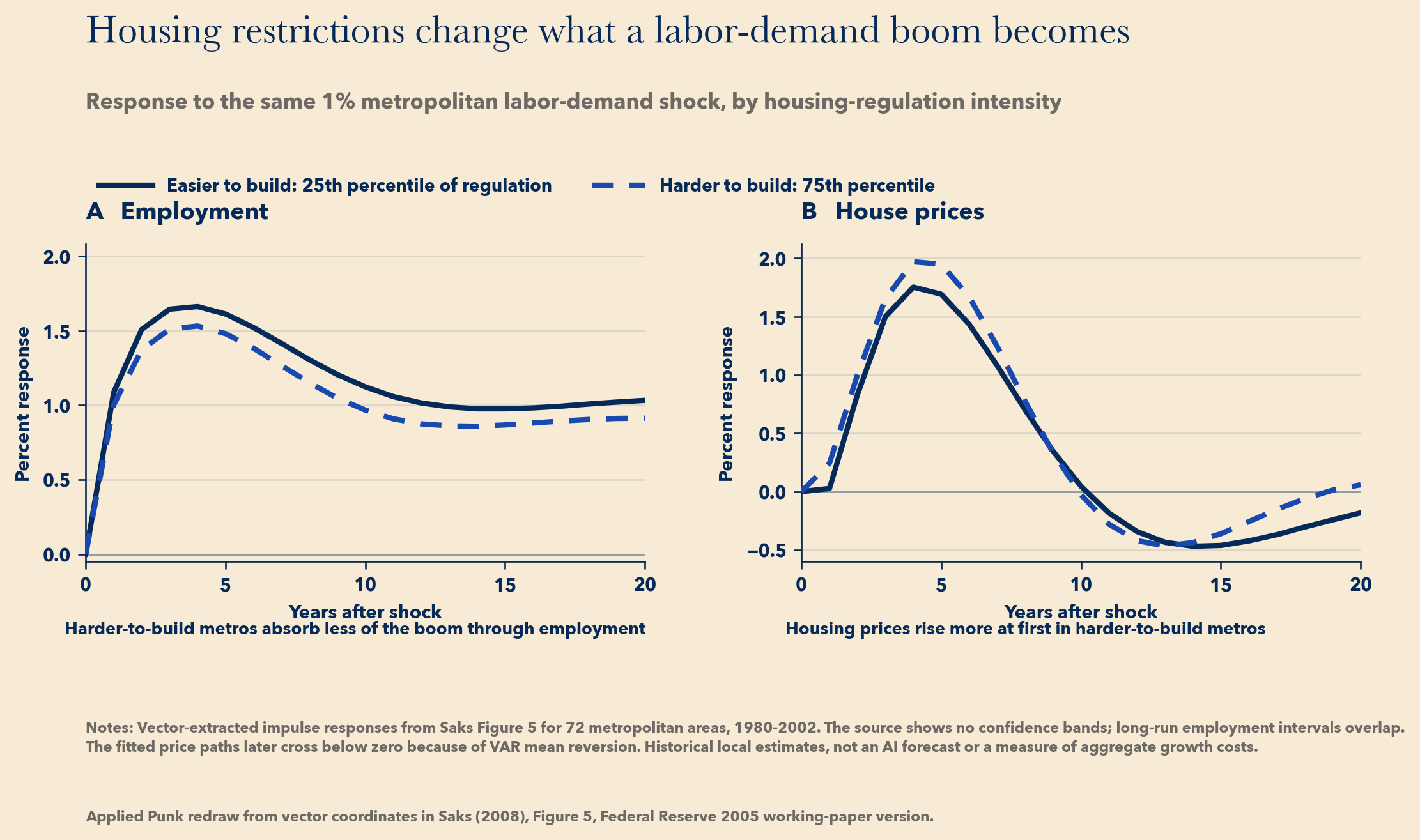
Figure 3. The same 1 percent labor-demand shock produces a smaller employment response and a larger short-run house-price response at the 75th percentile of housing-supply regulation than at the 25th percentile. The long-run employment estimates have overlapping bootstrap intervals, so this is evidence about the direction and mechanism of adjustment, not a precise estimate of aggregate growth costs or an AI forecast. Applied Punk redraw from vector coordinates in Saks (2008), Figure 5, Federal Reserve 2005 working-paper version.
The figure is the missing link between housing and the labor market. When construction responds less, a boom draws in fewer workers and creates more pressure on the price of existing homes. The long-run employment paths are not statistically separable with precision, but the pattern is the one the mechanism predicts.
Nathaniel Baum-Snow and Lu Han estimate average neighborhood supply elasticities of 0.29 for housing units and 0.51 for floor space. More importantly, variation within metropolitan areas exceeds variation between them. The ability to add housing is not one citywide fact. It changes from neighborhood to neighborhood with developable land, existing density, construction costs, delays, and regulation. About half of the estimated unit response comes through new construction, with changes to existing structures doing the rest. Baum-Snow and Han (2024)
AI is new. This mechanism is not. Peter Ganong and Daniel Shoag found that rising housing prices and tighter land-use regulation redirected lower-skill migration away from high-income places and weakened regional income convergence. Housing affects who can follow opportunity. Ganong and Shoag (2017)
Housing restrictions are not the only constraint, zoning is not the only determinant of supply, and every restriction is not pointless. New residents require transportation, utilities, schools, and public space. The relevant question is whether institutions respond to growth by adding capacity or by rationing access through higher prices.
If housing expands, the first productivity gain can bring in more workers, support more firms, deepen the market, and help generate another gain. If housing remains fixed, more of the gain becomes rent and land value. Fewer people enter. The cluster is smaller than it could have been. The next turn of the loop begins with less. We do not yet know the size of that effect for AI. But we know which way the constraint works.
The Industrial Revolution’s miracle was not that machines made their owners rich. That part was easy. The miracle was that productive capacity kept expanding. Competition lowered prices, cheap goods created mass demand, investment expanded capacity, and workers eventually earned more in an economy where their wages bought more.
AI can begin the same process. It can make intelligence cheaper and raise the value of the people and places that use it well. But the first productivity gain is not the final outcome.
AI will create a real dividend. Whether it becomes broad abundance depends in part on whether productive places admit more participants or auction access among those already inside.
Sources and data
Robert C. Allen, “Engels’ Pause: Technical Change, Capital Accumulation, and Inequality in the British Industrial Revolution” (Explorations in Economic History, 2009), source.
Nicholas Crafts, “Slow Real Wage Growth during the Industrial Revolution: Productivity Paradox or Pro-Rich Growth?” (Oxford Economic Papers, 2022), source.
C. Knick Harley, “Cotton Textile Prices and the Industrial Revolution” (Economic History Review, 1998), source.
C. Knick Harley, “Was Technological Change in the Early Industrial Revolution Schumpeterian?” (Explorations in Economic History, 2012), source.
Tim Leunig and Hans-Joachim Voth, “Spinning Welfare: The Gains from Process Innovation in Cotton and Car Production” (CEP Discussion Paper 1050, 2011), source and Figure 2 data.
Alan L. Olmstead and Paul W. Rhode, “Cotton, Slavery, and the New History of Capitalism” (Explorations in Economic History, 2018), source.
Ezra Klein and Derek Thompson, Abundance (Avid Reader Press/Simon & Schuster, 2025), source.
Ezra Klein, “AI and the Public Good with Ezra Klein” (May 20, 2026), audio.
Erik Brynjolfsson, Danielle Li, and Lindsey Raymond, “Generative AI at Work” (Quarterly Journal of Economics, 2025), source.
John Mondragon and Johannes Wieland, “Housing Demand and Remote Work” (Federal Reserve Bank of San Francisco Working Paper 2022-11, revised 2025), source.
Richard Hornbeck and Enrico Moretti, “Estimating Who Benefits from Productivity Growth” (Review of Economics and Statistics, 2024), source.
Raven E. Saks, “Job Creation and Housing Construction: Constraints on Metropolitan Area Employment Growth” (Journal of Urban Economics, 2008), source.
Peter Ganong and Daniel W. Shoag, “Why Has Regional Income Convergence in the U.S. Declined?” (Journal of Urban Economics, 2017), source.
Mark Muro and Shriya Methkupally, “Mapping the AI Economy” (Brookings Metro, 2025), source.
Nathaniel Baum-Snow and Lu Han, “The Microgeography of Housing Supply” (Journal of Political Economy, 2024), source.