


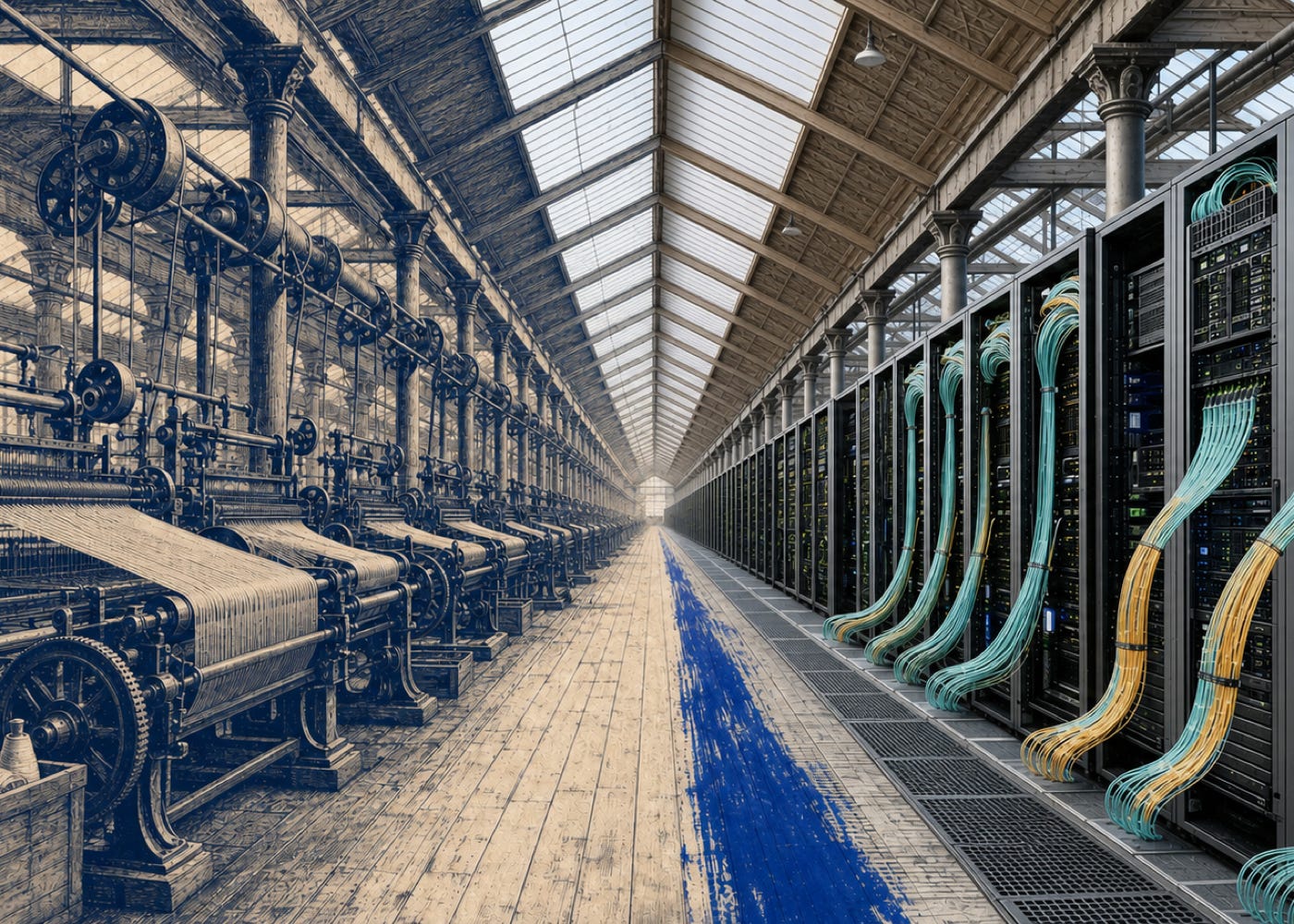
Will artificial intelligence replace you? I don’t know. But a job is not a single thing that vanishes the moment a machine learns one part of it; it is a bundle of tasks, and those tasks do not contribute equally to your wage, autonomy, or bargaining power. So “Will AI take my job?” is the wrong first question: the right one is which tasks it takes, what happens to the worker who performed them, and whether the resulting power shifts toward labor or capital.
That question has been hiding inside automation for two centuries. The Industrial Revolution transferred tasks performed by human bodies to machines. The digital revolution transferred routine information work to computers. Artificial intelligence now reaches into writing, diagnosis, analysis, and judgment. The object of automation is changing. The labor-market mechanism is not. A machine performs a task, a worker’s time is released, the job is rebuilt, and the value of the remaining work changes.
A Tale of Two Jobs
Handloom Weavers in Early Nineteenth-Century Britain
Britain’s handloom weavers show what happens when automation reaches the task around which an occupation’s economic value is organized. Weaving was not one minor duty inside a larger job. It was the productive task supporting the worker’s skill, wage, and bargaining power. The power loom did not need to reproduce everything a weaver knew. It only needed to produce cloth more cheaply and at greater scale.
Employment initially rose. The estimated number of handloom weavers increased from roughly 184,000 in 1806 to 240,000 by 1820 and remained near that level through 1831. Wages moved in the opposite direction. Estimated weekly earnings fell from 240 old pence in 1806 to 99 in 1820 and 72 in 1831. Employment eventually followed, falling to roughly 3,000 workers by 1862. (Wood 1910, Table 41, pp. 127–128)
The sequence matters. The occupation remained large after its economic foundation had begun to erode. Wages registered the change before employment did. Watching the number of jobs alone would have missed the first half of the story.
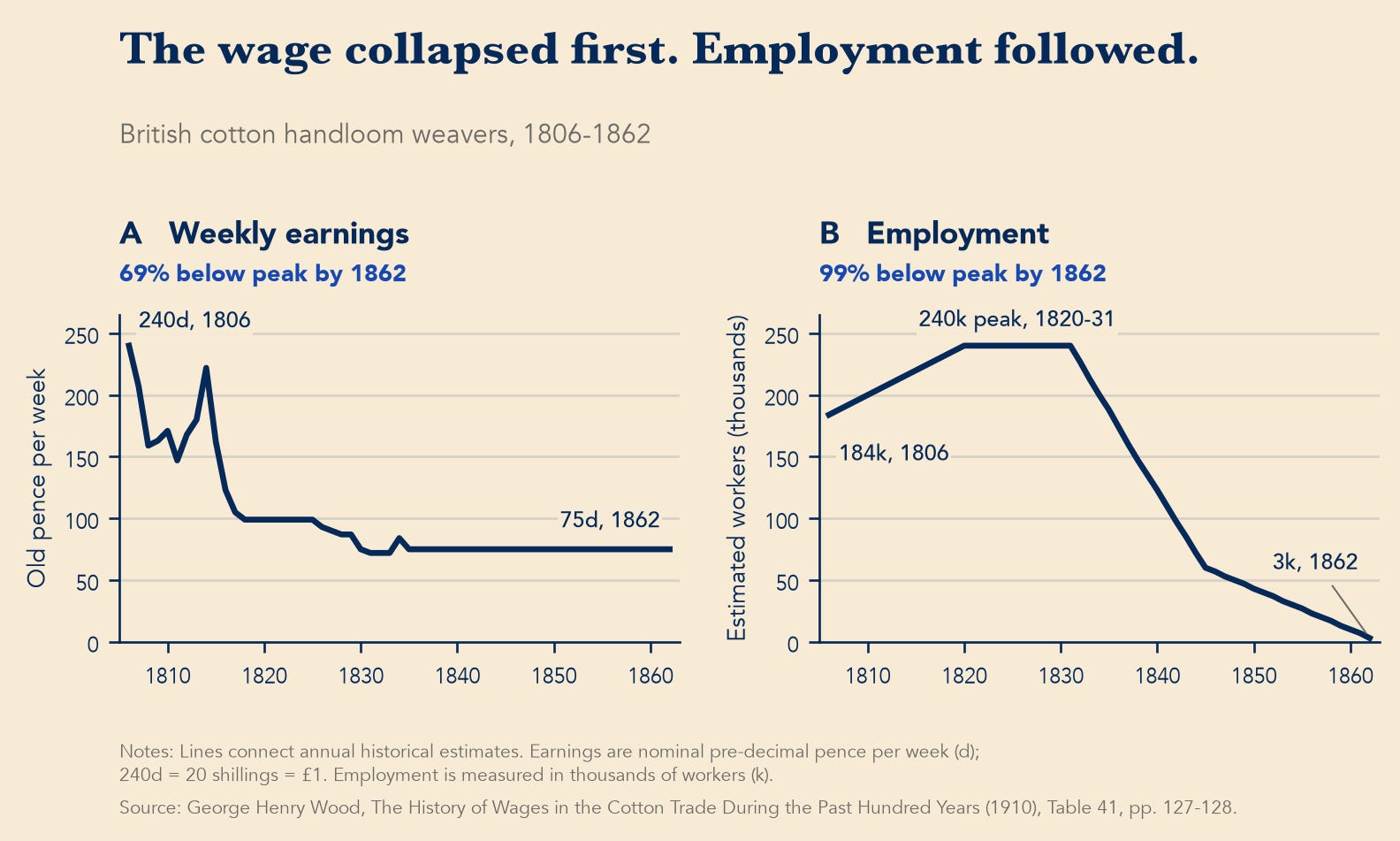
Figure 1: Estimated weekly earnings and employment among British cotton handloom weavers, 1806–1862. Lines connect annual historical estimates; earnings are nominal pre-decimal pence per week and employment is measured in thousands of workers. Source: Wood (1910), Table 41, pp. 127–128.
Radiologists Two Centuries Later
Radiology appeared to offer artificial intelligence a clean target. In 2016, Geoffrey Hinton predicted that deep learning would soon outperform radiologists. The logic seemed direct: radiology had converted diagnosis into digital images just as machine learning was becoming extraordinarily good at recognizing patterns in images. (Handel 2022)
But image recognition is not the occupation. Radiologists compare scans with patient histories, determine which anomaly matters, communicate uncertainty, guide procedures, manage risk, and assume responsibility for the report. Even reading images contains different tasks. Clearing a routine study, locating a suspicious region, resolving an ambiguous finding, and deciding what happens next are not the same work.
A Swedish mammography trial made that decomposition visible. Investigators randomly assigned 105,934 women to standard screening or an AI-supported workflow. The AI assigned risk scores, helped determine whether an examination received one or two human readings, and marked suspicious findings. The AI-supported group required 61,248 human readings, compared with 109,692 under standard double reading. That was a 44.2 percent reduction in screen-reading workload. Cancer detection rose from 5.0 to 6.4 cases per thousand women screened, with no statistically significant increase in the false-positive rate. This was one workflow, not a forecast for every radiology department. (Hernström et al. 2025)
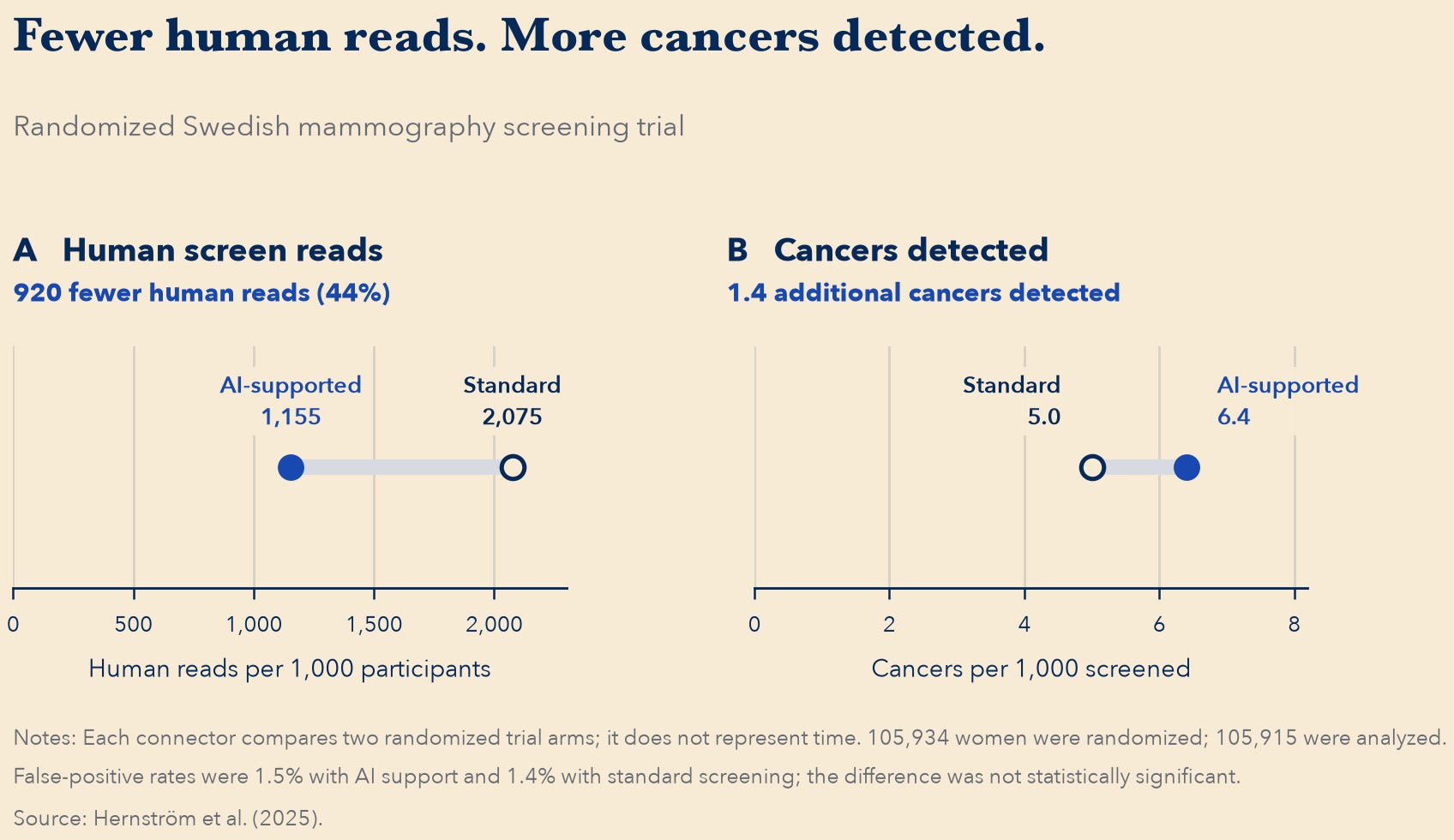
Figure 2: Human screen-reading workload and cancers detected in the randomized MASAI mammography trial. The trial measures one screening workflow, not the radiology profession. Source: Hernström et al. (2025).
Nor did the measured Medicare-enrolled radiologist population collapse as medical-image AI improved. U.S. Medicare-enrolled radiologists rose from 30,723 in 2014 to 36,024 in 2023. Through 2019, our CPI-adjusted calculation from Malhotra et al.’s plotted median diagnostic-radiology compensation series shows real pay rose about 2 percent outside academia and 5 percent in academic practice. From 2019 to 2023, it fell about 10 percent and 2 percent, respectively. That break overlaps COVID-19, which disrupted imaging volumes and compensation, and the inflation surge that followed. The sources do not estimate the effect of AI. They show something narrower: measured headcount and pre-pandemic real pay did not experience a handloom-style collapse. (Christensen et al. 2024; Malhotra et al. 2025; U.S. Bureau of Labor Statistics 2024)
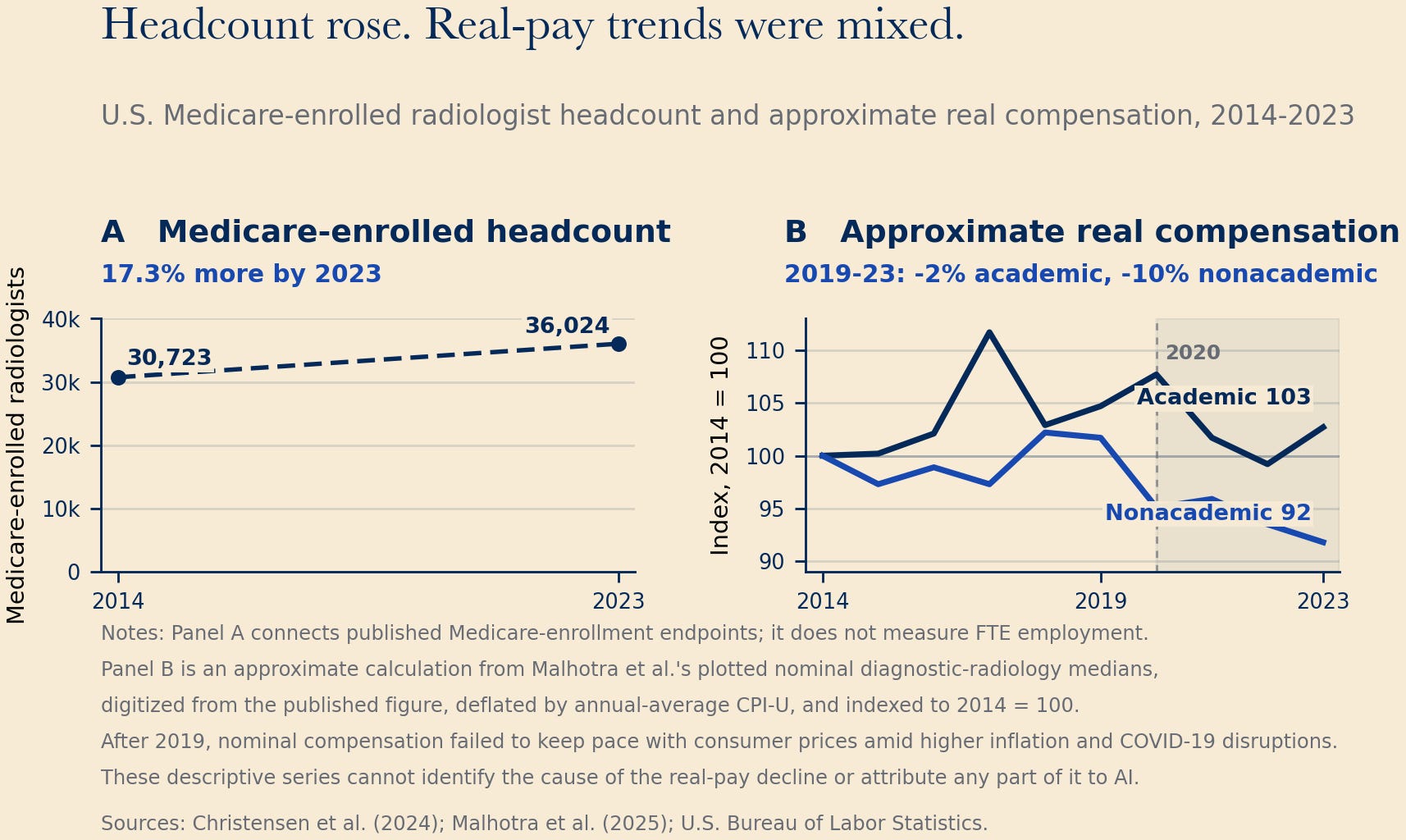
Figure 3: Medicare-enrolled radiologist headcount rose while CPI-adjusted median diagnostic-radiology compensation in both settings remained stable or increased through 2019. Panel B is an approximate calculation from Malhotra et al.’s plotted nominal medians, deflated by annual-average CPI-U and indexed to 2014 = 100. The post-2019 decline overlaps COVID-19 and higher inflation and is difficult to disentangle the causal effect of the decline related to AI. Sources: Christensen et al. (2024); Malhotra et al. (2025); U.S. Bureau of Labor Statistics (2024).
The trial tells us what the technology made possible. It cannot tell us what happened to the labor it saved. The freed capacity could screen more patients, reduce a backlog, create more time for difficult cases, raise the number of readings expected from each physician, or reduce the number of labor hours purchased. Better clinical output does not determine who captures the economic gain.
The weaver and the radiologist therefore give us two outcomes, but not two simple morals. The power loom attacked the task around which the weaver’s value had been built. AI entered one part of a larger professional bundle and released capacity that could be redirected toward the work that remained. Both technologies automated tasks. Only one immediately made the worker easier to replace.
The Task-Based Framework: Displacement and Reinstatement
The handloom weaver and the radiologist point to the same mechanism. Production is divided into tasks, and those tasks can be assigned to workers or machines. Technology changes that assignment before it changes the occupation recorded in employment statistics. Acemoglu and Restrepo call this the task-based framework. Automation occurs when capital takes over a task previously performed by labor. The first economic change is therefore not the disappearance of a job. It is a change in the task content of production. (Acemoglu and Restrepo 2019)
A job title hides that structure. The Labor Department lists 30 tasks for radiologists. They include interpreting images, preparing reports, reviewing histories, communicating results, conferring with clinicians, determining procedures, performing interventions, and managing safety. (National Center for Occupational Information Network Development 2026) No single task is “the radiologist.” The occupation is the bundle, together with the judgment and responsibility attached to it.
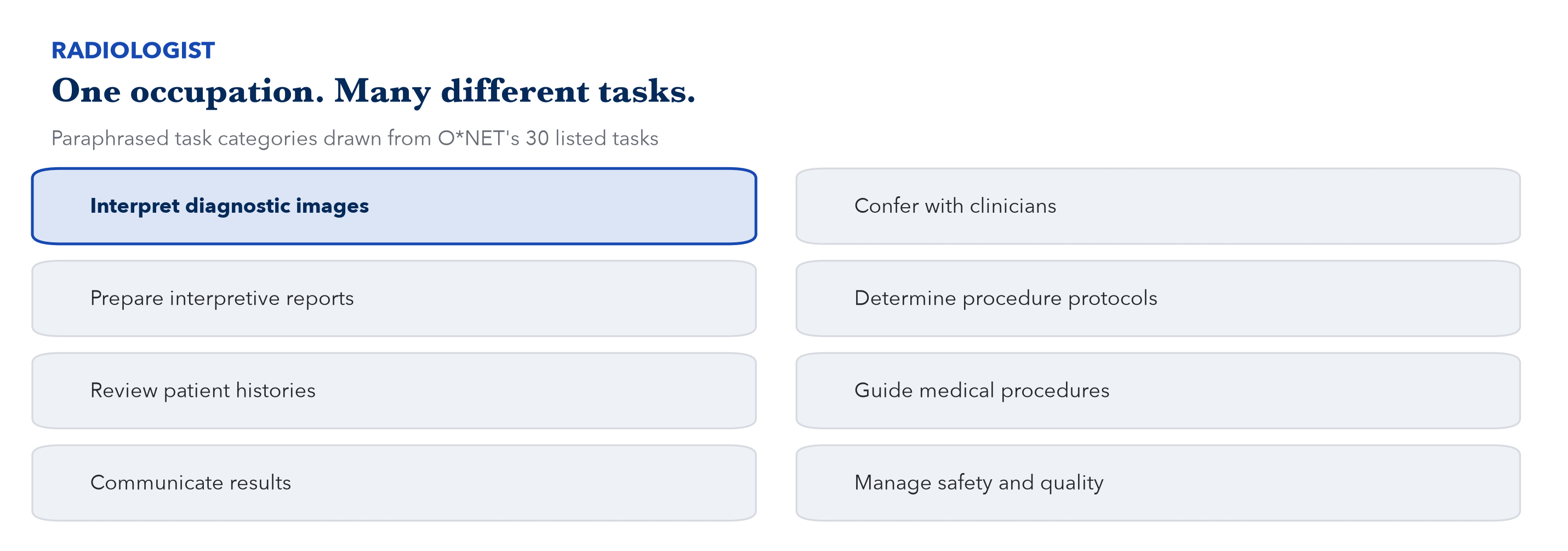
Figure 4: Paraphrased task categories drawn from the 30 tasks in the Labor Department’s 2026 radiologist profile. The highlighted category is the part of the bundle most directly reorganized in the MASAI screening workflow. Source: National Center for Occupational Information Network Development (2026).
The model separates three forces that public discussion often collapses into one. Automation creates a displacement effect: holding output fixed, fewer labor hours are required for the tasks the machine now performs. Lower costs also create a productivity effect. Output may expand, increasing demand for the human work that remains. Innovation can then create new tasks in which labor has an advantage. Acemoglu and Restrepo call this the reinstatement effect. Displacement removes labor from existing tasks. Productivity can expand the market. Reinstatement creates new reasons to employ labor. (Acemoglu and Restrepo 2018, 2019)
That is why automation does not simply subtract an activity from a fixed job. Once a machine performs a task, the worker has time to do something else. That time can become more output, more difficult cases, a service that was previously too expensive, shorter work, or fewer labor hours purchased. The occupation is rebundled around the new division of labor. The resulting bundle then becomes the starting point for the next round of automation.
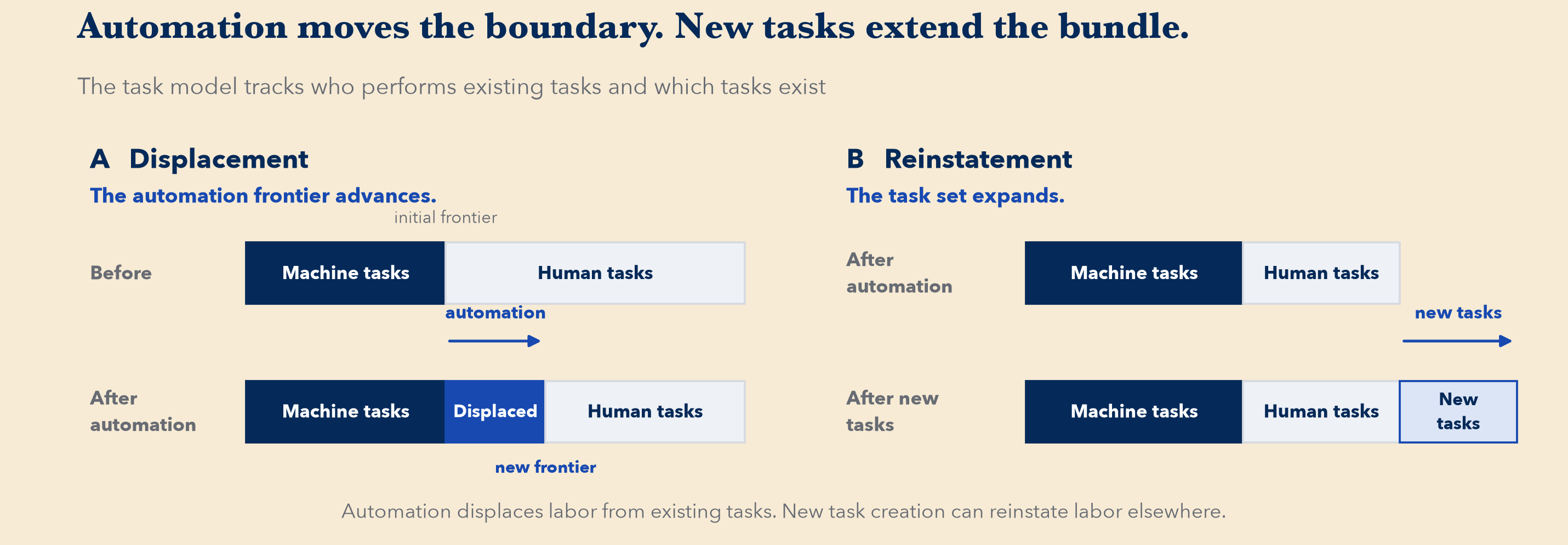
Figure 5: Schematic of displacement and reinstatement in the task-based framework. Automation moves the automation frontier, transferring existing tasks from labor to capital. New task creation extends the task set in activities assigned to labor. Conceptual illustration based on Acemoglu and Restrepo (2018, 2019).
The contrast between the weaver and the radiologist now becomes precise. The power loom automated the productive task around which the weaver’s market value had been organized. In mammography, AI reduced routine readings inside a broader bundle of interpretation, intervention, communication, and responsibility. The mechanism was the same. The location of the automated task inside the occupation was not.
The balance between displacement and reinstatement is not automatic. Demand matters. If one radiologist can read twice as many scans and the number of scans remains fixed, fewer reading hours are required. If lower cost and faster diagnosis expand screening enough, demand for radiologists can grow. Control matters too. A productivity gain can become better service, higher output targets, narrower discretion, or fewer paid hours. Employment, wages, autonomy, and bargaining power can therefore move in different directions.
Exposure studies show where this process might begin. Eloundou and coauthors rated O*NET tasks according to whether a large language model, alone or with complementary software, could reduce completion time by at least half without lowering quality. They then aggregated those task ratings into occupation-level exposure indices. (Eloundou et al. 2024)
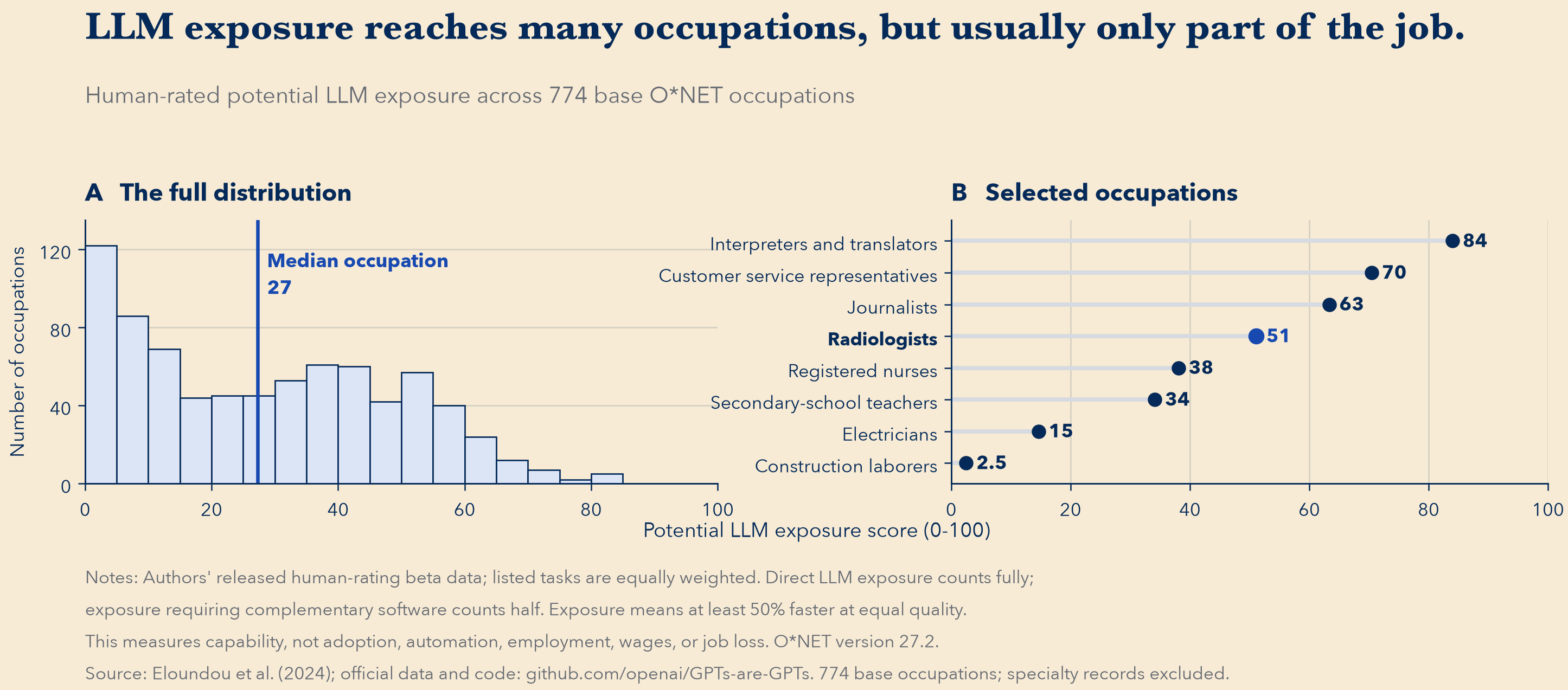
Figure 6: Human-rated potential LLM task exposure across 774 base occupation records, with specialty records excluded. Scores describe technical capability, not predicted job loss. Source: Eloundou et al. (2024); OpenAI’s GPTs-are-GPTs data and code repository.
So, Will AI Take Your Job?
Figure 6 does not divide occupations into safe and doomed groups. It measures the potential exposure of existing tasks under one study’s assumptions. Radiologists scored 51, but that is not a 51 percent probability of losing the job. The score does not tell us whether a system will be adopted, whether it will replace or assist the worker, how demand will respond, or whether new tasks will emerge. It also measures exposure to language models, not every form of AI.
The task-based framework supplies a map, not a verdict. So, will AI take your job? It depends on which tasks it takes. It depends on whether the remaining tasks become more valuable, whether lower costs create more demand, whether new tasks arrive, and whether the current worker can reach them. It also depends on how labor and capital bargain over the time and productivity released by the machine. (Acemoglu and Johnson 2024)
History permits optimism and caution. Robert Allen estimates that British output per worker rose 46 percent between 1780 and 1840 while the real wage rose only 12 percent. During this Engels’ Pause, productivity advanced for decades before workers shared proportionately in the gain. Between 1840 and 1900, output per worker rose 90 percent and the real wage 123 percent. Crafts’s newer estimates substantially narrow the gap and challenge Allen’s distributional interpretation, although consumption earnings still lagged productivity for part of the period. The abundance was real. So was the delay. (Allen 2009; Crafts 2022)
New work is not hypothetical. Autor and coauthors find that a majority of current U.S. employment is in job specialties introduced since 1940. That does not mean new work will arrive quickly enough, in the right places, or in forms accessible to displaced workers. It shows that the task set can expand. (Autor et al. 2024)
AI is already moving automation into knowledge work. If the same intelligence enters robots, it may return to physical work with greater reach. Goods and services that are scarce today could become cheap. That is a possibility, not a promise. AI may make abundance possible. How that abundance is divided will emerge from the continuing interaction between labor and capital.
Sources and notes
Acemoglu, Daron, and Simon Johnson. “Learning from Ricardo and Thompson: Machinery and Labor in the Early Industrial Revolution and in the Age of Artificial Intelligence.” Annual Review of Economics 16 (2024): 597-621.
Acemoglu, Daron, and Pascual Restrepo. “The Race between Man and Machine: Implications of Technology for Growth, Factor Shares, and Employment.” American Economic Review 108, no. 6 (2018): 1488-1542.
Acemoglu, Daron, and Pascual Restrepo. “Automation and New Tasks: How Technology Displaces and Reinstates Labor.” Journal of Economic Perspectives 33, no. 2 (2019): 3-30.
Allen, Robert C. “Engels’ Pause: Technical Change, Capital Accumulation, and Inequality in the British Industrial Revolution.” Explorations in Economic History 46, no. 4 (2009): 418-435.
Autor, David, Caroline Chin, Anna Salomons, and Bryan Seegmiller. “New Frontiers: The Origins and Content of New Work, 1940-2018.” Quarterly Journal of Economics 139, no. 3 (2024): 1399-1465.
Christensen, Eric W., YoonKyung Chung, Elizabeth Y. Rula, and Jay R. Parikh. “Changes in the Radiology Practice Landscape and Indicators of Practice Consolidation From 2014 to 2023.” American Journal of Roentgenology 223, no. 2 (2024).
Crafts, Nicholas. “Slow Real Wage Growth During the Industrial Revolution: Productivity Paradox or Pro-Rich Growth?” Oxford Economic Papers 74, no. 1 (2022): 1-13.
Eloundou, Tyna, Sam Manning, Pamela Mishkin, and Daniel Rock. “GPTs Are GPTs: Labor Market Impact Potential of LLMs.” Science 384, no. 6702 (2024): 1306-1308. Occupation-level exposure data.
Handel, Michael J. “Growth Trends for Selected Occupations Considered at Risk from Automation.” Monthly Labor Review (2022).
Hernström, Veronica, et al. “Screening Performance and Characteristics of Breast Cancer Detected in the Mammography Screening with Artificial Intelligence Trial (MASAI).” The Lancet Digital Health 7, no. 3 (2025): e175-e183.
Malhotra, Ajay, et al. “Recent Trends in Academic Versus Nonacademic Radiologist Compensation and Clinical Productivity.” Journal of the American College of Radiology 22, no. 4 (2025): 486-494.
National Center for O*NET Development. “O*NET OnLine: Radiologists, 29-1224.00.” Accessed August 15, 2026.
U.S. Bureau of Labor Statistics. “Consumer Price Index for All Urban Consumers: U.S. City Average, All Items.” 2024.
Wood, George Henry. The History of Wages in the Cotton Trade During the Past Hundred Years. Manchester: Sherratt and Hughes, 1910.